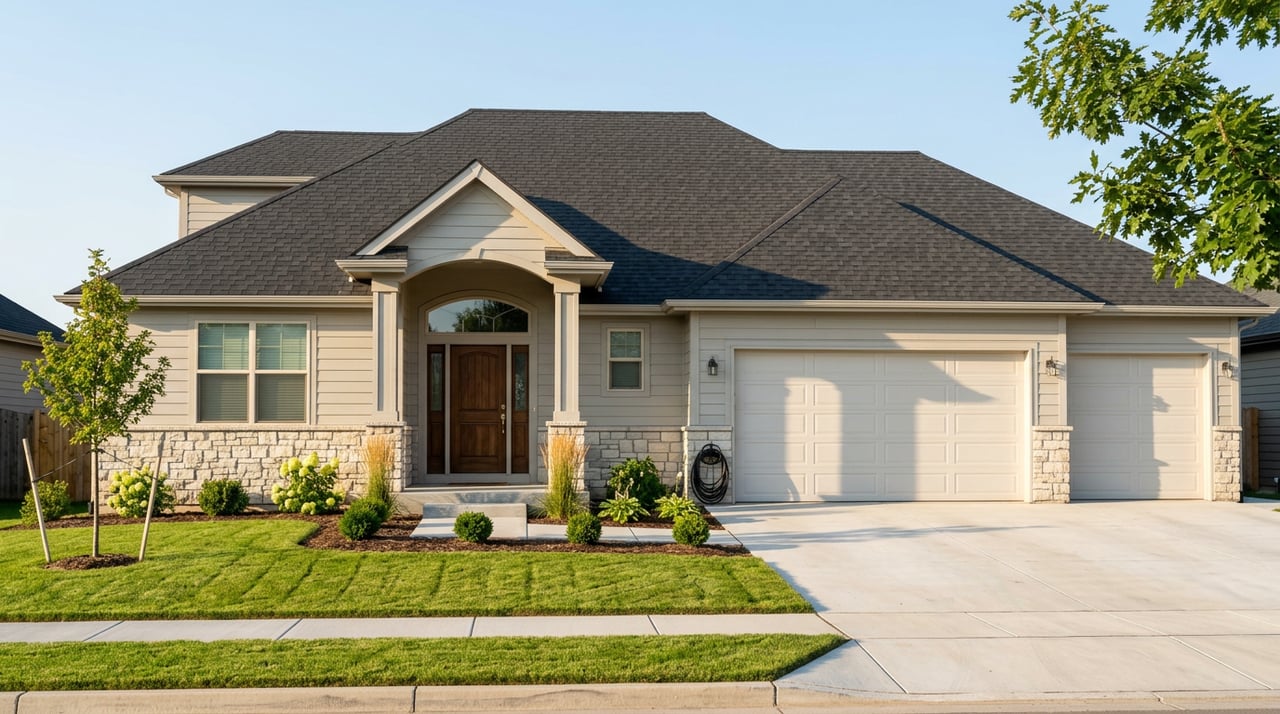
Walk two Overland Park listings this summer, both priced right around $520,000. One is a new build going up in 66221, backed by the builder's preferred lender. The other is a well-maintained resale a few miles north in 66204, listed by an owner who priced it to match. On paper, they look like the same decision. They are not. The new build likely comes with a rate buydown built into the deal. The resale doesn't have one to offer. Same number on the sign, two very different mortgages.
That gap is the thing worth understanding before you write an offer in this market, whether you're the buyer choosing between them or the resale seller wondering why your showings slowed down the week a new phase opened nearby.
The Sticker Isn't The Deal
Builders have a reason to avoid cutting a home's list price even when they need to move inventory faster. A public price cut lowers the appraised comp for every neighbor who already closed at the higher number. So builders reach for a different lever: they pay down the buyer's interest rate instead. Kiplinger's June 2026 breakdown of the practice put it plainly, noting that builders can advertise lower monthly payments without officially reducing the home's base price, which protects the community's value on paper while still getting the buyer to a payment they can stomach.
The mechanics are standard across the industry. A temporary 2-1 buydown cuts the rate by two points in year one, one point in year two, then reverts to the full note rate. A permanent buydown lowers the rate for the life of the loan, paid for with discount points at closing. Either way, the buyer's monthly number drops without the list price ever moving.
Here's the catch Kiplinger flags for anyone comparing a new build against a resale at a similar price: if the new home costs meaningfully more than comparable resale inventory even after the incentive is factored in, you're financing the perk, not the value. That difference doesn't show up until you try to refinance or sell.
Where This Shows Up On The Ground
Overland Park's citywide numbers make the market look like one thing. Redfin's data for the three months ending May 2026 put the median sale price at $495,000, essentially flat year over year, with homes selling in about 9 days and buyers fielding roughly 3 offers apiece. Johnson County as a whole posted a median of $499,000 in June 2026, up 2.9% from a year earlier, according to Heartland MLS figures.
Those countywide and citywide numbers blend two very different transactions. Price per square foot tells the real story. As of this spring, citywide Overland Park ran somewhere between $215 and $245 per square foot. But split it by zip and the range splits with it: 66204 and 66212, the older north and central pockets, ran $190 to $210 per square foot. Head south to 66221 and 66223, where most of the active new construction sits, and the range jumped to $250 to $285 per square foot.
That's not simply "newer homes cost more." It's that the 66221 and 66223 numbers already have builder incentives priced in. Builders active there this summer include Don Julian Builders, with a 66221 community pricing from $539,950 to $1,138,603, James Engle Custom Homes in the same zip at $529,000 to $769,000, Roeser Homes with a recently reduced entry point starting at $320,490, and C&M Builders in 66223, where one plan lists from $1,244,655 for a 6-bedroom, 4-bath, 3,845-square-foot home. Sunwest Design And Build has active plans in 66221 as well. That same spring reporting put two subdivisions in 66221, LionsGate and Nottingham St. Andrews, at medians north of $750,000 on their own.
A resale seller competing against that inventory isn't just competing on square footage and finishes. They're competing against a builder who can quietly lower a buyer's rate by two points in year one without touching the price on the listing sheet.
| Submarket | Price per square foot (2026) | What's actually driving it |
|---|---|---|
| 66204 & 66212 (north/central) | $190 to $210 | Resale competing purely on note rate, no incentive lever |
| 66221 & 66223 (south) | $250 to $285 | New construction with builder rate buydowns priced into the list |
| Historic Overland Park | $296, up 20.5% year over year | No builder inventory, pure resale scarcity |
The Pocket Where None Of This Applies
Historic Overland Park is worth a separate look precisely because the incentive story doesn't touch it. There's no builder there offering a buydown. Over the three months ending May 2026, the median sale price was $272,000, up 3.8% from a year earlier, but the price per square foot climbed 20.5% over the same period, and homes sold in an average of 14 days, down from 19 days the year before. Only 10 homes changed hands there in May 2026, down from 12 the prior year.
That's a market moving on scarcity alone. Fewer homes, tighter turnover, buyers who want the walkable older streets and can't get that from a new-construction plan. It's the clearest proof that the financing-driven price behavior in 66221 and 66223 isn't how the whole city works. It's specific to the submarket where builders have standing inventory to move.
What This Means If You're Selling Resale Near New Construction
If your home sits in or near 66204, 66212, or another resale-heavy pocket, and a builder is actively selling comparable square footage a few zips over, the instinct to cut your price to compete is usually the wrong move. A price cut doesn't answer what the builder is actually offering, which is a lower payment, not a lower number. A seller-paid temporary rate buydown or a closing cost credit aimed at the buyer's monthly payment competes on the same terms the builder is using. Dropping the list price competes on a different axis entirely and usually costs you more equity than the incentive would have.
If you're the buyer standing between a new build and a resale at similar money, ask for the incentive breakdown in writing before you compare the two. Get the actual note rate, the buydown structure, and whether the builder's preferred lender is a requirement for the incentive to apply. Run the payment on both homes at their real rates, not the sticker price. A resale a little cheaper on paper can still cost more per month than a new build carrying a builder-funded rate buydown, and the reverse is just as true once that buydown period ends.
None of this shows up in a citywide median. It shows up zip by zip, lender by lender, and in the fine print of who's actually paying for the rate you'll carry.
If you're weighing a new build against a resale in Overland Park, or trying to price a resale competitively against builders with standing inventory nearby, Jamie Howell can walk through the real numbers with you, not just the list price. Schedule Your Free Consultation to get a read on what your specific comparison actually costs, month to month, before you write an offer.